

Paper Tablet for Long Meeting Notes: How Page Space Changes Your Workflow
When a long meeting outgrows the page
A paper tablet is better suited to long meeting notes when there is enough writing room to keep an explanation and its supporting details together. A page break is not a problem by itself. The trouble starts when the next page no longer makes clear which question, objection or idea it continues.
Allow for the discussion to change shape: an agenda item may finish in three lines, while an unexpected concern takes half a page. A larger writing area can reduce cramped handwriting and awkward breaks, but page continuity still depends on how the notes are organised. The aim is to preserve the thread, not to fit an entire meeting onto one screen.
The busiest part of a meeting reveals how much space you need
Meeting length alone is a poor way to estimate note space. An hour of presentations may produce fewer handwritten pages than twenty minutes of detailed questions, sketches and interruptions. It is the densest part of the conversation that shows whether the writing area feels restrictive.
Look at notes from two or three comparable sessions. Notice where handwriting became smaller, where a diagram was squeezed into a corner, or where a point ran across several pages. These are more useful signals than the number of pages in a tidy meeting.
For professionals who regularly record complex discussions, paper tablets for handwritten work are worth comparing by usable writing space rather than portability alone. Someone who writes only occasional prompts may make a different choice from someone who follows a debate in detail.
Agenda sections rarely need equal space
A neatly divided agenda can become a constraint once the meeting begins. Setting aside the same amount of space for every topic assumes each will receive similar attention. Real conversations rarely behave that way.
Rather than deciding in advance how much room each agenda item deserves, leave space to follow the discussion as it develops. A brief status update may need only a few lines, while a question involving competing proposals, diagrams or several rounds of clarification may need much more. Start with a clear heading and let the importance of the discussion determine how far the notes continue.
Consider a team expecting a brief discussion about delivery dates and a longer one about budgets. The delivery question then opens up a detailed exchange about changing requirements. The notes should follow the discussion, not the original time allocation, so the delivery section gets the space it needs.
An overflow page should still feel like the same discussion
For long meeting handwriting, the most useful page reference is often a simple one. At the bottom of an unfinished section, write something like “Delivery dates — continued on p. 4”. Begin the next page with “Delivery dates — from p. 3”. These are ordinary handwritten cues, not automatic links.
That small connection preserves the subject even if the next page opens with a reply or qualification rather than a complete sentence. If the meeting moves away and returns to the issue later, say “Delivery dates — resumed from p. 3” instead. It is more accurate than making two separated passages appear consecutive.
Keep page numbers consistent within the meeting. An overflow page without a clear source reference is easy to misread, especially when several agenda sections share similar vocabulary.
Short markers make a changing conversation easier to follow
Detailed notes do not need to capture every sentence. When a discussion moves quickly, preserve the reasoning, the point of disagreement and any reference needed to understand what follows. Writing every word can leave less room for the details that explain how the conversation developed.
A brief timestamp can help when the group returns to an earlier topic. For example, “11:20 — delivery dates revisited” makes the change in direction clear without filling the page with unnecessary time labels. Use it alongside topic headings and page references, rather than treating timestamps as a substitute for them.
After the meeting, review each page break in sequence. If the first line on a continuation is difficult to understand without the previous page, add a short topic heading or source-page reference. This small check can make the notes easier to follow later without rewriting them as formal minutes.
For a broader approach to organising handwritten notes across recurring work, see our digital notebook workflow guide. This article focuses on a narrower question: keeping one long meeting's notes connected across pages.
For long meetings, writing room matters more than features
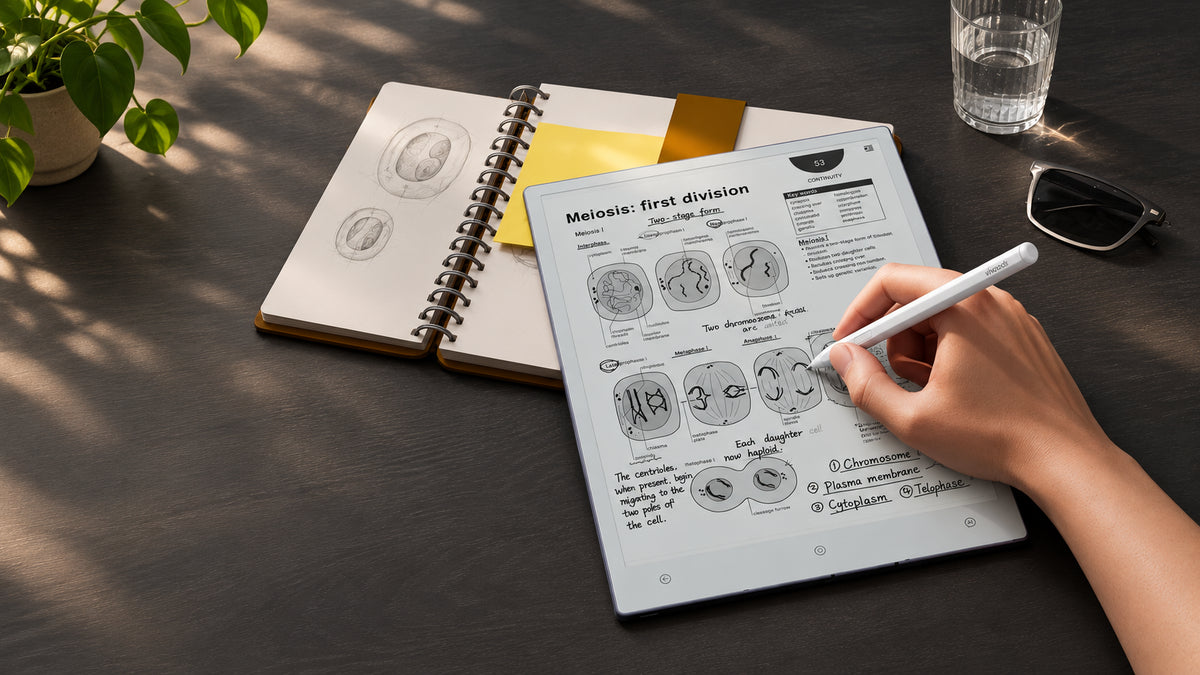
The larger screen matters most when a meeting produces several connected layers of information: the original proposal, questions from the room, a quick diagram and the clarification that follows. Keeping more of that material visible together can make it easier to follow the discussion, although it does not replace clear page references when the notes continue elsewhere. The trade-off is practical: a larger device takes more space in a bag or on a crowded table.
Viwoods AiPaper is the larger-format option to consider within the Viwoods range for this kind of sustained handwriting. The smaller AiPaper Mini may still suit shorter notes and more frequent carrying. The relevant distinction is writing room, not a list of extra features.

Before deciding, try a representative agenda in your usual handwriting size. Leave space for a detour, then consider whether the page remains readable without constant rearranging. A paper tablet with more room is worthwhile only if that room addresses the interruptions you actually encounter.
If longer sessions regularly carry one topic across several cramped pages, compare the available writing formats with page continuity in mind. If your notes are brief and easy to follow already, carrying a larger device may offer little advantage.
Frequently asked questions
How should I connect an overflow page?
Write the destination page number beside the unfinished point, then repeat the topic and source page at the start of the continuation. If the discussion returns much later, mark it as resumed rather than continuous.
Do detailed notes need to be a transcript?
No. Keep the reasoning, distinctions and questions that explain the discussion. Capture exact wording only when the phrasing itself matters.
What if an agenda changes halfway through?
Add a new heading where the change occurs. A brief timestamp or reference to the interrupted topic will help preserve the sequence without rewriting earlier pages.


Commenta
Questo sito è protetto da hCaptcha e applica le Norme sulla privacy e i Termini di servizio di hCaptcha.